The next time you open your fridge, take a second to behold the miracles inside of it: Raspberries from California, butter from New Zealand, steak from Nebraska. None of that would have been remotely possible before the creation of the cold chain.
The cold chain is the name for the end-to-end refrigeration of our food from farm to truck to warehouse to grocery store and ultimately to our fridges at home. And it’s one of the great achievements of the modern world.
On today’s show, Nicola Twilley, food journalist and author of Frostbite: How Refrigeration Changed Our Food, Our Planet, and Ourselves, tells us the story of how our world got cold, and what that’s meant for the economy.
We’ll hear about two pioneers of cold: The cheapskate meat baron Gustavus Swift, and the train-hopping chemist Polly Pennington. And we’ll take a look at whether all this refrigeration might have created some new problems.
Subscribe to Planet Money+
Listen free: Apple Podcasts, Spotify, the NPR app or anywhere you get podcasts.
Facebook / Instagram / TikTok / Our weekly Newsletter.
Today’s episode of Planet Money was hosted by Nick Fountain and Alexi Horowitz-Ghazi. It was produced by James Sneed and edited by Keith Romer. It was fact-checked by Sierra Juarez and engineered by Valentina Rodríguez Sánchez. Alex Goldmark is Planet Money‘s executive producer.
See pcm.adswizz.com for information about our collection and use of personal data for sponsorship and to manage your podcast sponsorship preferences.

NPR Privacy Policy
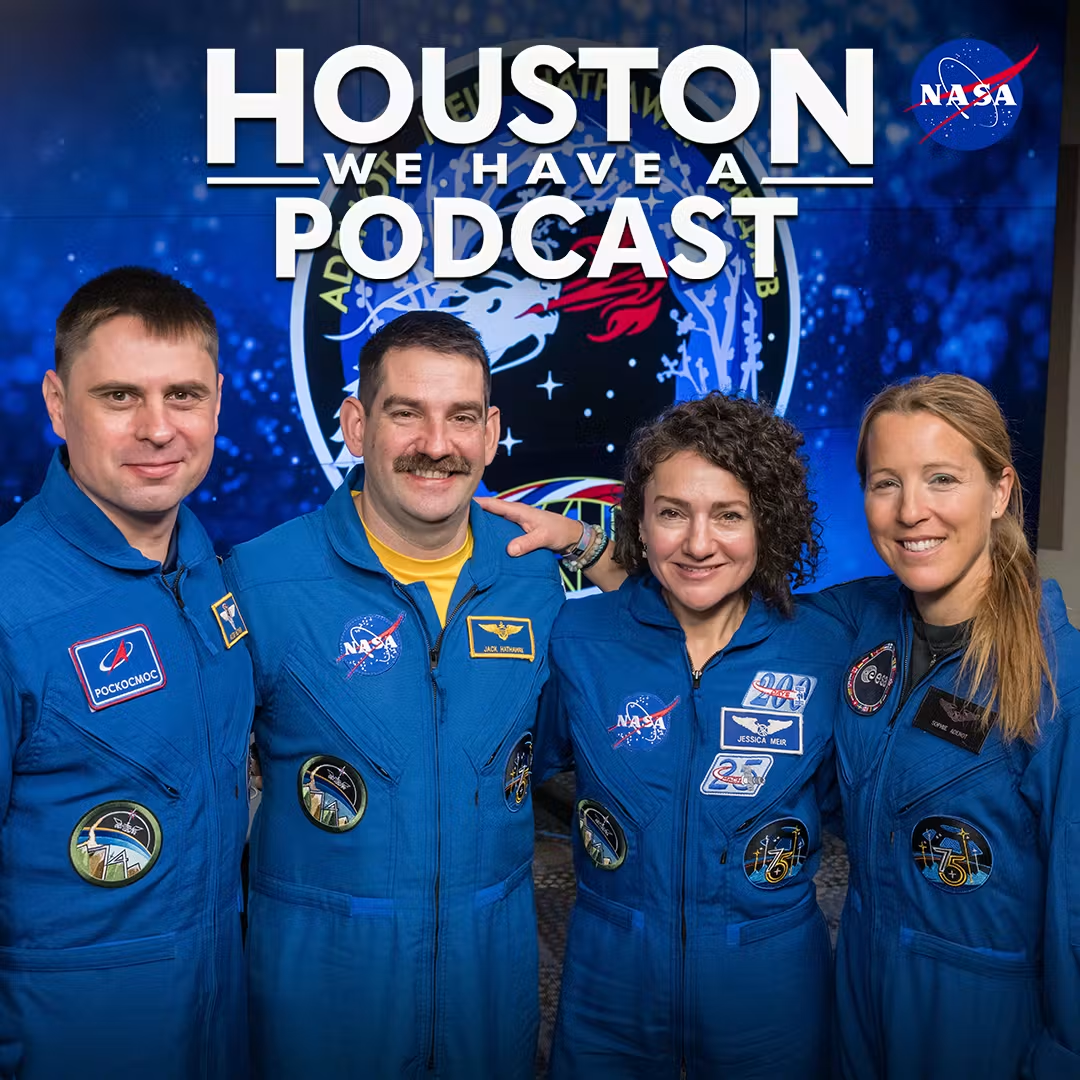
NASA’s all-American 2025 astronaut candidates share a little about
themselves by playing a fun icebreaker game. HWHAP 402.
Since childhood, Joshua Roman’s life revolved around the cello. But when long COVID forced him to set his cello aside, he had to rethink his approach to life, faith and music.
TED Radio Hour+ subscribers now get access to bonus episodes, with more ideas from TED speakers and a behind the scenes look with our producers. A Plus subscription also lets you listen to regular episodes (like this one!) without sponsors. Sign-up at plus.npr.org/ted.
See pcm.adswizz.com for information about our collection and use of personal data for sponsorship and to manage your podcast sponsorship preferences.
NPR Privacy Policy
On Wall Street, fortunes are often won and lost with the tiniest advantages. And for the past few years, one trading firm has stood out from the rest for both huge profits and careful secrecy — Jane Street Group.
But last year, one of Jane Street’s biggest and most lucrative trading strategies was unexpectedly revealed in a Manhattan courtroom. The news ricocheted around the world. It drew the attention of competitors and regulatory agencies, destabilized billions of dollars worth of trades, and called into question some of the most fundamental strategies in global finance.
Some Planet Money episodes about finance:
– The rise and fall of Long Term Capital Management
– How George Soros forced the UK to devalue the pound
Further reading:
– Jane Street Group, LLC v. Millennium Management LLC, Douglas Schadewald, and Daniel Spottiswood
– “Jane Street’s Indian Options Trade Was Too Good,” from Bloomberg
– SEBI’s report: “Interim Order in the matter of Index manipulation by Jane Street Group”
– “Jane Street Defends India Trading Activity, Blasts Regulator,” from Bloomberg
Subscribe to Planet Money+
Listen free: Apple Podcasts, Spotify, the NPR app or anywhere you get podcasts.
Facebook / Instagram / TikTok / Our weekly Newsletter.
This episode was hosted by Alexi Horowitz-Ghazi and Mary Childs. It was produced by Eric Mennel, with production help from Sam Yellowhorse Kesler and Cooper Katz-McKim. It was edited by Jess Jiang. Fact-checking by Sierra Juarez. Planet Money’s executive producer is Alex Goldmark.
See pcm.adswizz.com for information about our collection and use of personal data for sponsorship and to manage your podcast sponsorship preferences.
NPR Privacy Policy
Israel has been blocking the flow of physical money into Gaza since the start of the war. So whatever paper cash was in Gaza before the war, that’s all that’s been circulating. It’s falling apart from overuse.
Two best friends, one in Gaza and one in Belgium, are now trying to get money in.
But how do you get money into a bank account in Gaza? And how do you get that money out, in Gaza, when there are no functioning banks or ATMs? And almost no electricity. And spotty internet. And what is there to buy? How does money even work in Gaza right now?
Subscribe to Planet Money+
Listen free: Apple Podcasts, Spotify, the NPR app or anywhere you get podcasts.
Facebook / Instagram / TikTok / Our weekly Newsletter.
This episode was hosted by Sarah Gonzalez. It was produced by Sam Yellowhorse Kesler. It was edited by Marianne McCune, and fact-checked by Sierra Juarez. It was engineered by Cena Loffredo, Robert Rodriguez, and James Willetts. Alex Goldmark is Planet Money’s executive producer.
See pcm.adswizz.com for information about our collection and use of personal data for sponsorship and to manage your podcast sponsorship preferences.

NPR Privacy Policy
Big life decisions are never easy. Should you follow a plan? Make a hard pivot? Improvise as you go? This hour, TED speakers who’ve made extreme life choices and their advice for getting unstuck. Guests include comedian and musician Reggie Watts, biomedical researcher Sonia Vallabh and conservationist Kristine McDivitt Tompkins.
Original broadcast date: October 18, 2024
TED Radio Hour+ subscribers now get access to bonus episodes, with more ideas from TED speakers and a behind the scenes look with our producers. A Plus subscription also lets you listen to regular episodes (like this one!) without sponsors. Sign-up at: plus.npr.org/ted
See pcm.adswizz.com for information about our collection and use of personal data for sponsorship and to manage your podcast sponsorship preferences.

NPR Privacy Policy
(Note: A version of this episode originally ran in 2016.)
It’s no secret that CEOs get paid a ton – and a ton more than the average worker. More than a hundred times than what their average employee makes.
But it wasn’t always this way. So, how did this gap get so vast? And why?
On today’s episode … we go back to a specific moment when the way CEOs were paid got changed. It involves Bill Clinton’s campaign promises, and Silicon Valley workers taking to the streets to protest an accounting rule. And of course, Dodd Frank.
Subscribe to Planet Money+
Listen free: Apple Podcasts, Spotify, the NPR app or anywhere you get podcasts.
Facebook / Instagram / TikTok / Our weekly Newsletter.
This episode was hosted by Jacob Goldstein and Stacey Vanek Smith, and was originally produced by Nick Fountain. This update was reported and produced by Willa Rubin and edited by Alex Goldmark.
See pcm.adswizz.com for information about our collection and use of personal data for sponsorship and to manage your podcast sponsorship preferences.
NPR Privacy Policy
Last month, President Donald Trump announced an unusual deal. Intel, the biggest microchip maker in America, had agreed to give the United States a 10 percent stake in its business. That means the U.S. government is now Intel’s largest shareholder — and a major American company is now a partially state-owned enterprise.
This deal has raised a lot of eyebrows. The U.S. government almost never gets tangled up with businesses like this. Some have accused the president of taking a step toward, well, socialism.
But the Intel deal didn’t come out of nowhere. It’s actually the latest chapter in one of the most aggressive economic experiments the United States has ever attempted. An experiment that Trump is now taking in a surprising new direction.
On today’s show, we unpack the Intel deal. Where did it come from, and what does it say about President Trump’s unconventional approach to managing the economy.
For more:
– The President’s Golden Share in U.S. Steel
– Bringing a tariff to a graphite fight
– A controversial idea at the heart of Bidenomics
Subscribe to Planet Money+
Listen free: Apple Podcasts, Spotify, the NPR app or anywhere you get podcasts.
Facebook / Instagram / TikTok / Our weekly Newsletter.
This episode was hosted by Jeff Guo and Keith Romer. It was produced by Sam Yellowhorse Kesler. It was edited by Jess Jiang and fact-checked by Sierra Juarez. Engineering by Jimmy Keeley with help from Robert Rodriguez. Alex Goldmark is Planet Money’s executive producer.
See pcm.adswizz.com for information about our collection and use of personal data for sponsorship and to manage your podcast sponsorship preferences.

NPR Privacy Policy
NASA Artemis II launch director Charlie Blackwell-Thompson shares her
path to the console and what it takes to launch the first crewed Artemis
mission to the Moon. HWHAP 401.
The moonshot factory X is home to some of Silicon Valley’s boldest inventions. CEO Astro Teller reveals how the secretive lab tests crazy ideas that can change the world… even when they fail.
TED Radio Hour+ subscribers now get access to bonus episodes, with more ideas from TED speakers and a behind the scenes look with our producers. A Plus subscription also lets you listen to regular episodes (like this one!) without sponsors. Sign-up at plus.npr.org/ted.
See pcm.adswizz.com for information about our collection and use of personal data for sponsorship and to manage your podcast sponsorship preferences.

NPR Privacy Policy