We sit down with the legendary Charlie Munger in the only dedicated longform podcast interview that he has done in his 99 years on Earth. We’ve gotten to have some special conversations on Acquired over the years, but this one truly takes the cake. Over dinner at his Los Angeles home, Charlie reflected with us on his own career and his nearly 50-year partnership at Berkshire Hathaway with Warren Buffett. He offered lessons and advice for investors today, and of course he shared his speech on the virtues of Costco once again (among other favorite investments). We’re so glad that we got the opportunity to record and share this with you all — break out your notebooks, tune in, and enjoy the singular wit and wisdom of Charlie Munger.
A transcript is available here.
Sponsor:
More Acquired!:
© Copyright 2023 ACQ, LLC
Note: Acquired hosts and guests may hold assets discussed in this episode. This podcast is not investment advice, and is intended for informational and entertainment purposes only. You should do your own research and make your own independent decisions when considering any financial transactions.
You might expect to find economic concepts in the pages of an economics textbook. But you know where you can really see a lot of economic concepts in action? Buffets.
Here at Planet Money we believe there’s a lot of economics going on at the all-you-eat buffet, tucked in between the mountains of brisket and troughs of mashed potatoes. From classic concepts like adverse selection, sunk costs, diminishing marginal returns, to more exotic economic mysteries, like the flat rate pricing bias.
Today on the show, we’re headed to the place where the modern buffet may have been born: Las Vegas. Our mission? To feast ourselves on all the economics we can handle at the all-you-can-eat buffet. And along the way, an economist and fellow buffet-lover will teach us his hyper-rational strategy for optimizing his buffet experience.
Today’s show was produced by James Sneed and Nick Fountain with help from Emma Peaslee. It was edited by Jess Jiang, engineered by James Willetts, and fact-checked by Sierra Juarez. Alex Goldmark is our executive producer.
Help support Planet Money and get bonus episodes by subscribing to Planet Money+ in Apple Podcasts or at plus.npr.org/planetmoney.
See pcm.adswizz.com for information about our collection and use of personal data for sponsorship and to manage your podcast sponsorship preferences.
NPR Privacy Policy
Original broadcast date: November 4, 2022. For millennia, humans have created artifacts of their lives — from art, to books, to music. This hour, we explore ideas about capturing the ephemeral human experience for future generations to find. Guests include paleoanthropologist Genevieve von Petzinger, museum curator Ariana Curtis, music curator Alexis Charpentier and artist Katie Paterson.
TED Radio Hour+ subscribers now get access to bonus episodes, with more ideas from TED speakers and a behind the scenes look with our producers. A Plus subscription also lets you listen to regular episodes (like this one!) without sponsors. Sign-up at: plus.npr.org/ted
See pcm.adswizz.com for information about our collection and use of personal data for sponsorship and to manage your podcast sponsorship preferences.
NPR Privacy Policy
The CHAPEA crew gives an update in their third month of a one-year stay in a simulated Mars habit, and Dr. Scott Smith discusses the nutrition science of the analog mission. This is the third audio log of a monthly series. HWHAP Episode 311.
Right now, a lot of school districts across the country are making a pretty giant change to the way public education usually works. Facing teacher shortages and struggling to fill vacant spots, they are finding a new recruitment tool: the four-day school week.
Those districts are saying to teachers, “You can have three-day weekends all the time, and we won’t cut your pay.” As of this fall, around 900 school districts – that’s about 7% of all districts in the U.S. – now have school weeks that are just four days long.
And this isn’t the first time a bunch of schools have scaled back to four days, so there is a lot of data to lean on to figure out how well it works. In this episode, teachers love the four-day school week, and it turns out even parents love it, too. But is it good for students?
This episode was produced by Sam Yellowhorse Kesler with help from Willa Rubin. It was edited by Molly Messick and engineered by Maggie Luthar. Fact-checking by Sierra Juarez. Alex Goldmark is our executive producer.
Help support Planet Money and get bonus episodes by subscribing to Planet Money+ in Apple Podcasts or at plus.npr.org/planetmoney.
See pcm.adswizz.com for information about our collection and use of personal data for sponsorship and to manage your podcast sponsorship preferences.
NPR Privacy Policy
In part four: host Manoush Zomorodi explores the connection between our posture and our mood. A lot of us associate our neck and back pain with spending hours hunched over our phones and laptops. But what if that hunched posture is also making us feel tired, stressed, and anxious? Neuroscientist Peter Strick discusses his groundbreaking research on why exercising our core muscles lowers our stress.
Also in this episode: how a faulty, incorrect study went viral — claiming smartphones were causing people to grow horns on their backs. Science journalist Nsikan Akpan sets the record straight. Later, writer Paul Ingraham shares his daily strategy for doing movement snacks and strength building while balancing deadlines.
Click here to find out more about the project: npr.org/bodyelectric
Are you signed up for Columbia’s study, or following along with the series? We want to hear from you! Send us a voice memo at bodyelectric@npr.org. Talk to us on Instagram @ManoushZ, and on Facebook @tedradiohour.
See pcm.adswizz.com for information about our collection and use of personal data for sponsorship and to manage your podcast sponsorship preferences.
NPR Privacy Policy
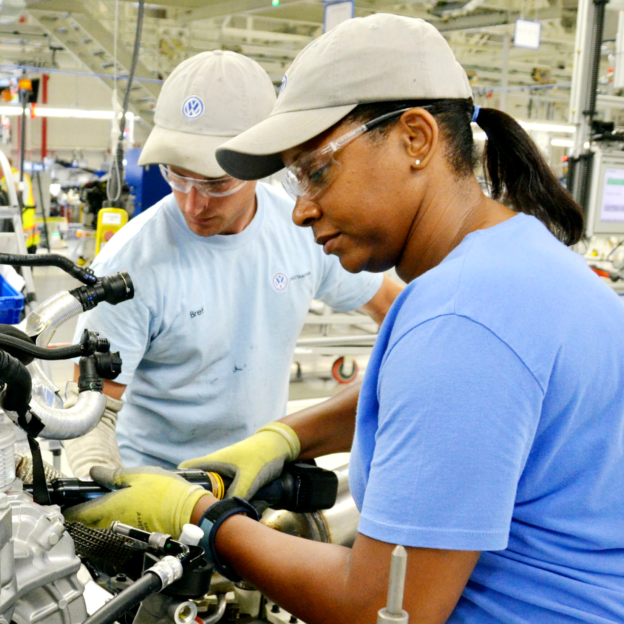
Union membership in the U.S. has been declining for decades. But, in 2022, support for unions among Americans was the highest it’s been in decades. This dissonance is due, in part, to the difficulties of one important phase in the life cycle of a union: setting up a union in the first place. One place where that has been particularly clear is at the Volkswagen plant in Chattanooga, Tennessee.
Back in 2008, Volkswagen announced that they would be setting up production in the United States after a 20-year absence. They planned to build a new auto manufacturing plant in Chattanooga.
Volkswagen has plants all over the world, all of which have some kind of worker representation, and the company said that it wanted that for Chattanooga too. So, the United Auto Workers, the union that traditionally represents auto workers, thought they would be able to successfully unionize this plant.
They were wrong.
In this episode, we tell the story of the UAW’s 10-year fight to unionize the Chattanooga plant. And, what other unions can learn from how badly that fight went for labor.
This episode was hosted by Amanda Aronczyk and Nick Fountain. It was produced by Willa Rubin. It was engineered by Josephine Nyounai, fact-checked by Sierra Juarez, and edited by Keith Romer. Alex Goldmark is our executive producer.
Help support Planet Money and get bonus episodes by subscribing to Planet Money+ in Apple Podcasts or at plus.npr.org/planetmoney.
See pcm.adswizz.com for information about our collection and use of personal data for sponsorship and to manage your podcast sponsorship preferences.
NPR Privacy Policy
Sometimes, the only way to make an impact is to be loud. This hour, three female performers talk about the rewards — and consequences — that come from speaking out and making people feel uncomfortable. Guests include comedian Lilly Singh, Pussy Riot co-founder Nadya Tolokonnikova and actor, playwright and director Sarah Jones.
TED Radio Hour+ subscribers now get access to bonus episodes, with more ideas from TED speakers and a behind the scenes look with our producers. A Plus subscription also lets you listen to regular episodes (like this one!) without sponsors. Sign-up at: plus.npr.org/ted
See pcm.adswizz.com for information about our collection and use of personal data for sponsorship and to manage your podcast sponsorship preferences.
NPR Privacy Policy
NASA Innovative Advanced Concepts leaders Mike LaPointe and John Nelson discuss unique and interesting solutions to complex spaceflight challenges. HWHAP Episode 310.
When someone says “the economy is doing well”—what does that even mean? Like, for workers, for employers, for the country as a whole? According to what calculation? How do you put a number on it?
The world of economics is filled with all sorts of “measuring sticks.” GDP. Inflation. Unemployment. Consumer sentiment. Over time, all kinds of government agencies, universities and private companies have come up with different ways to measure facets of the economy. These measures factor into all kinds of huge decisions—things like government policy, business strategies, maybe even your personal career choices or investments.
On today’s show, we’re going to lift the curtain on two of these yardsticks. We are going to meet the people tasked with sticking a number on two huge measures of our economic well being: the official U.S. government inflation report and the monthly unemployment and jobs numbers. Come along and see how the measures get made.
This episode was hosted by Darian Woods, Stacey Vanek Smith, and Wailin Wong. It was produced by Julia Ritchey and Jess Kung with help from James Sneed. Engineering by Gilly Moon and James Willetts. It was fact-checked by Michael He and Corey Bridges, and edited by Kate Concannon and Viet Le. Alex Goldmark is Planet Money’s executive producer.
Help support Planet Money and get bonus episodes by subscribing to Planet Money+ in Apple Podcasts or at plus.npr.org/planetmoney.
See pcm.adswizz.com for information about our collection and use of personal data for sponsorship and to manage your podcast sponsorship preferences.
NPR Privacy Policy