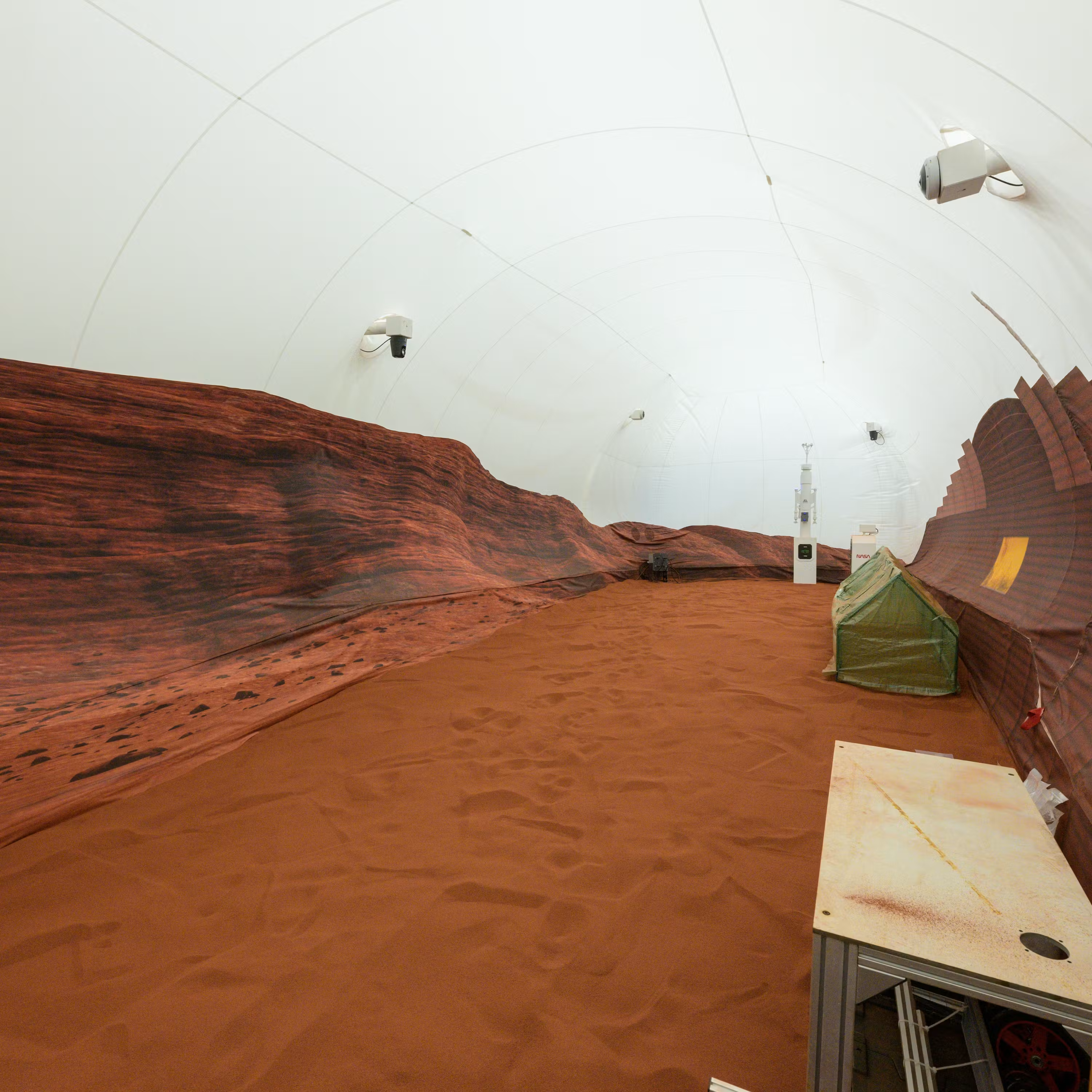
A project lead at NASA walks us through a new laser communication system that will be tested on the Artemis II mission to the Moon to drastically increase deep space data rates. HWHAP Episode 294.
Original broadcast date: July 29, 2022. For decades, Rosanne Cash has soared through the ranks of music with her powerhouse poetic skills and wistful reflections on her past. This hour, we explore Rosanne’s life and legacy through her music.
TED Radio Hour+ subscribers now get access to bonus episodes, with more ideas from TED speakers and a behind the scenes look with our producers. A Plus subscription also lets you listen to regular episodes (like this one!) without sponsors. Sign-up at: plus.npr.org/ted
See pcm.adswizz.com for information about our collection and use of personal data for sponsorship and to manage your podcast sponsorship preferences.
Twins are used to fielding all sorts of questions, like “Can you read each other’s minds?” or “Can you feel each other’s pain?” Two of our Planet Money reporters are twins, and they have heard them all.
But it’s not just strangers on the street who are fascinated by twins. Scientists have been studying twins since the 1800s, trying to get at one of humanity’s biggest questions: How much of what we do and how we are is encoded in our genes? The answer to this has all kinds of implications, for everything from healthcare to education, criminal justice and government spending.
Today on the show, we look at the history of twin studies. We ask what decades of studying twins has taught us. We look back at a twin study that asked whether genes influence antisocial behavior and rule-breaking. One of our reporters was a subject in it. And we find out: are twin studies still important for science?
(Note: This episode originally ran in 2019.)
Our show today was hosted by Sally Helm and Karen Duffin. It was produced by Darian Woods and Nick Fountain. It was edited by Bryant Urstadt.
Help support Planet Money and get bonus episodes by subscribing to Planet Money+ in Apple Podcasts or at plus.npr.org/planetmoney.
See pcm.adswizz.com for information about our collection and use of personal data for sponsorship and to manage your podcast sponsorship preferences.

People come from all over the world to work in U.S. tech. And during the tech boom years, the industry relied heavily on foreign workers. This is how we built Silicon Valley – with great minds coming from everywhere to work in the U.S.
But when the industry started to shrink, all of these people who moved here for work are finding that linking their jobs to their residency is really complicated. That was the case for Aashka and Nilanjan. Aashka was a product engineer at Amazon, and Nilanjan worked in digital advertising for Google. They both lost their jobs in the layoffs each company announced earlier this year.
When Aashka and Nilanjan got the news, a clock started ticking. Because they are both H-1B recipients, they only have 60 days to find new jobs before they risk being sent home. And they can’t get just any job – they need new employers in their field willing to sponsor their visa.
On today’s show, we followed two tech workers as they tried to find jobs before their visas expired, and what they went through as H-1B recipients trying to stay in the country.
This episode was hosted by Alyssa Jeong Perry and Amanda Aronczyk, produced by Sam Yellowhorse Kesler, engineered by James Willetts, fact-checked by Sierra Juarez, and edited by Molly Messick and Jess Jiang.
Help support Planet Money and get bonus episodes by subscribing to Planet Money+ in Apple Podcasts or at plus.npr.org/planetmoney.
See pcm.adswizz.com for information about our collection and use of personal data for sponsorship and to manage your podcast sponsorship preferences.
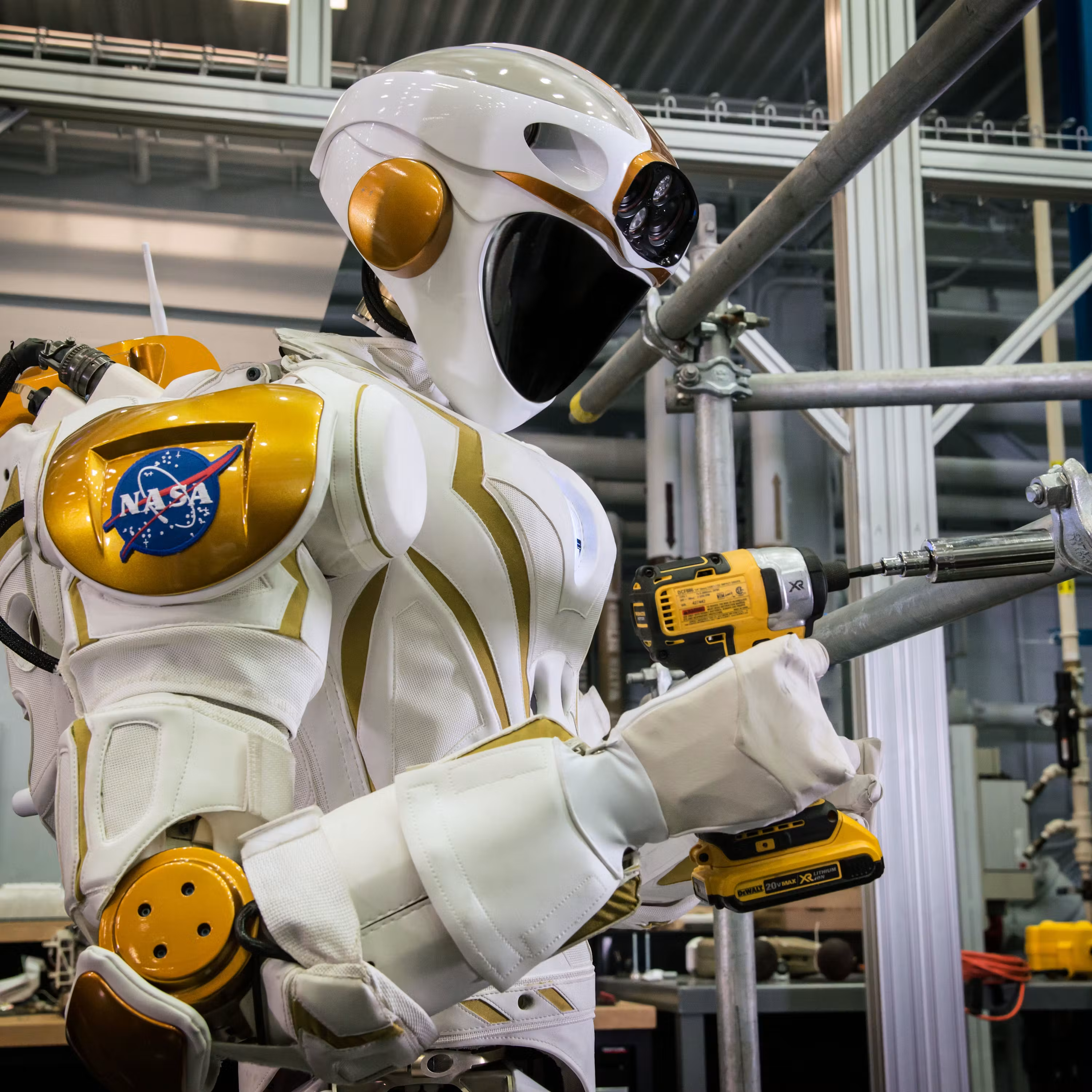
Experts at NASA’s Johnson Space Center discuss the new potable water dispenser that will soon be tested on the space station for future Artemis missions into deep space. HWHAP Episode 293.
Who will you be in 10 years? In 20 years? Envisioning how you will evolve is very hard. This hour, TED speakers share ideas on how to better plan for the future, while allowing for the unexpected. Guests include psychologist Hal Hershfield, journalist Shankar Vedantam, journalist Bina Venkataraman and philosopher Roman Krznaric.
TED Radio Hour+ subscribers now get access to bonus episodes, with more ideas from TED speakers and a behind the scenes look with our producers. A Plus subscription also lets you listen to regular episodes (like this one!) without sponsors. Sign-up at: plus.npr.org/ted
See pcm.adswizz.com for information about our collection and use of personal data for sponsorship and to manage your podcast sponsorship preferences.
Innovation is crucial for game-changing advancements in society, whether it’s treatments for serious diseases, developments in AI technology, or rocket science.
Today on the show, we’re airing two episodes from our daily economics show The Indicator. First, a new paper suggests that breakthrough innovations are more likely at smaller, younger companies. We talk to an inventor who left a big pharmaceutical company to start afresh, leading to some incredible treatments for serious diseases.
Then, it’s off to Mars — or at least, on the way. Elon Musk’s company SpaceX did a first test launch of a rocket meant to go all the way to the red planet. The rocket made it up off of the launch pad and lumbered briefly through the sky before self-destructing over the Gulf of Mexico. Suffice it to say, it’s not quite ready. NPR science correspondent Geoff Brumfiel walks us through SpaceX’s business plan as we try to figure out if this company has the funding and business acumen to reach its moonshot goal.
These two Indicator episodes were originally produced by Corey Bridges & Brittany Cronin, engineered by Katherine Silva & James Willets, and fact-checked by Dylan Sloan & Sierra Juarez. Kate Concannon edits the show.
The Planet Money version of this episode was produced by Willa Rubin, engineered by Robert Rodriguez, and edited by Keith Romer.
Help support Planet Money and get bonus episodes by subscribing to Planet Money+ in Apple Podcasts or at plus.npr.org/planetmoney.
See pcm.adswizz.com for information about our collection and use of personal data for sponsorship and to manage your podcast sponsorship preferences.

Uber CEO Dara Khosrowshahi dropped by the Acquired studio for an Eats delivery, so we broke out the cameras and asked him to hang out for a wide-ranging conversation. 🙂 We talk about his 20 years working with Barry Diller, starting his career at Allen & Company, how the Uber CEO search process ACTUALLY went down… and oh yeah, the massive transformation that’s happened at Uber over the past few years. When Dara took over the company it was bleeding huge sums of cash, losing share to competitors and embroiled in one of the biggest corporate controversies in recent memory. Fast forward to today and it’s turned cashflow positive while also having tripled revenue to over $30B (on $120B in GMV) and solidified its rideshare dominance in the US. And in perhaps the biggest change, it’s done it all while staying out of the headlines. Tune in!
Links
Sponsors:
More Acquired!
© Copyright 2015-2026 ACQ, LLC
Note: Acquired hosts and guests may hold assets discussed in this episode. This podcast is not investment advice, and is intended for informational and entertainment purposes only. You should do your own research and make your own independent decisions when considering any financial transactions.
In the early 90s, when a young economist named Michael Kremer finished his PhD, there had been a few economic studies based on randomized trials. But they were rare. In part because randomized trials – in which you recruit two statistically identical groups, choose one of them to get a treatment, and then compare what happens to each group – are expensive, and they take a lot of time.
But then, by chance, Michael had the opportunity to run a randomized trial in Busia, Kenya. He helped a nonprofit test whether the aid they were giving to local schools helped the students. That study paved the way for more randomized trials, and for other economists to use the method.
On today’s show, how Busia, Kenya, became the place where economists pioneered a more scientific way to study huge problems, from contaminated water to low graduation rates, to HIV transmission. And how that research changed government programs and aid efforts around the world.
This episode was produced by James Sneed with help from Willa Rubin. It was engineered by James Willetts. It was fact-checked by Sierra Juarez and Emma Peaslee. It was edited by Molly Messick. Jess Jiang is our acting executive producer.
Help support Planet Money and get bonus episodes by subscribing to Planet Money+ in Apple Podcasts or at plus.npr.org/planetmoney.
See pcm.adswizz.com for information about our collection and use of personal data for sponsorship and to manage your podcast sponsorship preferences.
The co-founder of the “Genes in Space” program joins the 2022 student winner to discuss this competition that allows students across the country to design an experiment for the International Space Station. HWHAP Episode 292.